
What Happens If Baler Cylinder Uses the Wrong Pin Size?
Using an incorrect pin size halts your replacement process because the components simply will not align, forcing you to stop production for expensive custom machining or parts reordering. You might think that a tiny difference in diameter is negligible when installing a new baler hydraulic cylinder, but in reality, that gap leads to catastrophic mechanical failure. This situation agitates your maintenance schedule, turning a routine afternoon swap into a multi-day logistical nightmare involving specialized machine shops. By following a strict measurement protocol, you ensure that your equipment returns to service immediately without the risk of vibrating itself to pieces.
Why Measure Your Baler Hydraulic Cylinder Eyelet First?
Measuring the eyelet first prevents you from receiving a baler hydraulic cylinder that is fundamentally incompatible with your existing mounting hardware. Even if you have the model number, wear and tear on the machine frame can change the dimensions of the attachment points over time. Relying on “factory specs” for a machine that has seen ten years of hard labor is a recipe for a sizing disaster.
The internal diameter of the eyelet must be matched to the pin with precision to avoid any unnecessary play or binding. If you skip this audit, you risk ordering a component that requires you to modify your machine frame, which is both time-consuming and structurally risky.
Is the Existing Pin Worn Beyond Recognition?
You should never use a worn pin as your primary reference for ordering new parts. Over thousands of cycles, friction reduces the diameter of the pin, meaning a measurement taken today will not reflect the original design.
- Standard pins lose material due to constant abrasive contact.
- Worn pins often develop an “hourglass” shape that hides the true diameter.
- Corrosion can swell a pin, making it appear larger than it actually is.
How to Determine the Actual Bore Diameter?
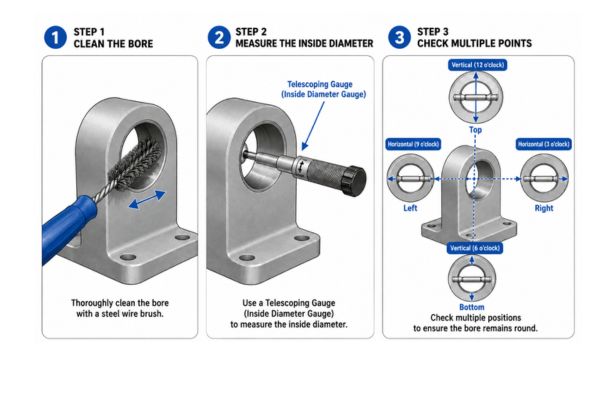
The most reliable way to find the correct size is to measure the bore of the mounting bracket on the baler itself. This gives you the maximum allowable diameter for your new pin and cylinder eyelet.
- Clean the bore thoroughly with a wire brush.
- Use a telescoping gauge to find the internal dimension.
- Check multiple points to ensure the hole is still round.
Does the Mounting Style Dictate Pin Selection?
The type of mount on your cylinder, whether it is a clevis, trunnion, or spherical bearing, changes how the pin interacts with the load. Different mounting styles require specific pin lengths and locking mechanisms to stay secure under pressure.
- Clevis mounts often require pins with cotter pin holes.
- Spherical bearings need pins that allow for slight angular misalignment.
- Trunnion mounts usually involve shorter, high-strength pivot pins.
Verifying these dimensions before your parts arrive ensures that you can complete the installation without needing to run to the hardware store for different fasteners.
| Eyelet Audit Step | Tool Required | Goal | |
|---|---|---|---|
| Clean Bore | Wire Brush | Remove debris for accuracy | |
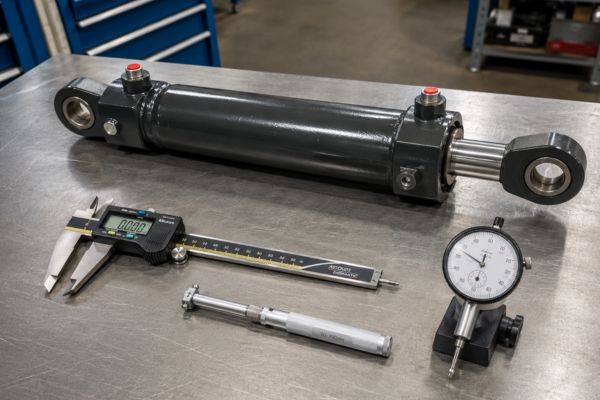
| Measure Diameter | Inside Micrometer | Determine exact bore size | |
| Check Roundness | Dial Indicator | Identify ovalization or wear |
How Does Wrong Pin Sizing Stall Baler Hydraulic Cylinder Repairs?
Incorrect sizing stalls repairs by creating physical barriers that prevent the secure attachment of the baler hydraulic cylinder to the machine frame. When you discover a size mismatch during assembly, you are forced to stop all work and assess whether you need to return the part or modify the pin. This interruption usually happens when your machine is already disassembled, leaving your baler out of commission and your production floor at a standstill.
Why Does On-Site Modification Lead to Production Delays?
Trying to “make it fit” on-site is a dangerous and slow process that rarely yields a professional result. Grinding down a pin or using a hand drill to enlarge an eyelet destroys the heat treatment and surface finish of the metal.
- Hand-grinding creates an uneven surface that causes hot spots.
- Enlarging holes manually often results in an off-center alignment.
- These “quick fixes” usually take hours and still result in a poor fit.
Will an Ill-Fitting Pin Void Your Component Warranty?
Most manufacturers will not honor a warranty claim if they find evidence of forced installation or improper mounting hardware. If the pin is too small, the resulting vibration can damage the cylinder’s internal seals and rod.
- Manufacturers can detect side-loading patterns caused by loose pins.
- Modified eyelets are considered unauthorized alterations.
- Warranty inspectors look for “beating” marks on the pin from forced entry.
How Do Forced Installations Damage Pivot Bushings?
Forcing a pin that is too large into a bushing can cause the bushing to crack or spin inside its housing. Once a bushing is damaged, the entire mounting bracket may need to be cut off and replaced, significantly increasing your repair costs.
- Excessive force deforms the delicate inner lining of the bushing.
- Spinning bushings wear out the parent metal of the baler frame.
- Replacing a pressed-in bushing requires specialized hydraulic pullers.
What Tools Are Needed for Baler Hydraulic Cylinder Pin Audits?
You need precision tools like digital calipers and bore gauges to audit a baler hydraulic cylinder pin and its corresponding housing. Standard tape measures are not accurate enough for hydraulic applications where a difference of 0.5mm can mean the difference between a smooth pivot and a seized joint. Using the right tools allows you to communicate exact specifications to your supplier, eliminating any guesswork from the ordering process.
Professional-grade measuring tools help you identify wear patterns that are invisible to the naked eye. This data is essential for determining if you simply need a new pin or if the entire mounting assembly requires a rebuild.
Why Are Calipers Essential for Precise Measurements?
Digital calipers provide the accuracy needed to measure both the outside diameter of the pin and the inside diameter of the eyelet. They allow you to switch between metric and imperial units instantly, which is vital in a global parts market.
- Calipers can measure depth, which is useful for checking pin recesses.
- They provide readings to three decimal places for total accuracy.
- The locking screw allows you to compare different pins quickly.
Can You Trust the Original Equipment Manufacturer Manual?
While the manual is a great starting point, you should always verify the physical dimensions on the machine. Aftermarket repairs or previous modifications by other technicians might have changed the original setup.
- Check the manual for the “as-built” specifications.
- Compare those numbers to your actual physical measurements.
- Document any discrepancies for future maintenance cycles.
How to Check for Eyelet Ovalization and Wear?
Ovalization occurs when the pin pounds against the eyelet over time, stretching the hole into an egg shape. A pin might fit in one direction but have massive “slop” in another, leading to premature cylinder failure.
- Measure the bore at 12 o’clock and 6 o’clock positions.
- Measure again at the 3 o’clock and 9 o’clock positions.
- If the difference is more than 0.010 inches, the eyelet is ovalized.
Why Do Nominal Sizes Lead to Incorrect Pin Selection?
Nominal sizes often lead to errors because they don’t account for the minute manufacturing tolerances required for a baler hydraulic cylinder fitment. A “1-inch pin” is rarely exactly 1.000 inches; it might be slightly undersized to allow for a sliding fit, or the hole might be slightly oversized. If you order based on the label rather than the actual measured dimension, you will likely end up with a pin that is either too loose or refuses to slide through the eyelet.
What Is the Difference Between Imperial and Metric Pins?
Many modern balers use a mix of metric and imperial components depending on where the sub-assemblies were manufactured. A 25mm pin and a 1-inch (25.4mm) pin look identical to the naked eye, but they are not interchangeable.
- A 0.4mm difference is enough to stop an installation entirely.
- Imperial pins use fractional increments (1/16, 1/32).
- Metric pins use whole millimeters or specific DIN standards.
Does Paint Thickness Affect the Final Fitment?
Heavy-duty equipment is often coated with thick industrial paint or powder coating that can significantly change the measured diameter of a hole. If you don’t account for this coating, your pin may not fit once it arrives at the installation site.
- Powder coating can add 0.1mm to 0.2mm to a surface.
- Paint inside an eyelet should be removed before measuring.
- Unpainted pins are usually preferred for precision fits.
Why Do Standard Catalog Sizes Often Result in Error?
Catalog sizes are designed for “new” applications and do not account for the expansion of holes due to years of heavy pressure. Choosing the closest match from a catalog without measuring your specific machine often results in selecting a pin that is too small for your worn eyelets.
- Catalogs prioritize high-volume, standard sizes.
- Your machine may have been built with custom-sized pins.
- Wear can make a standard pin size obsolete for your equipment.
| Size Type | Accuracy | Use Case | |
|---|---|---|---|
| Nominal | Low | General identification | |
| Actual | High | Part ordering and machining | |
| Tolerance-Adjusted | Very High | Final assembly verification |
Why Do Tolerances Matter for a Baler Hydraulic Cylinder Mount?
Precise tolerances ensure the baler hydraulic cylinder can pivot smoothly without excessive vibration or binding during high-pressure cycles. If the clearance between the pin and the hole is too wide, the shock loads from the cylinder’s extension will hammer the pin against the housing. Conversely, if the fit is too tight, the lack of space for lubrication will cause the metal surfaces to seize together, effectively locking the joint and preventing the cylinder from moving.
Managing these tolerances is a balancing act that requires an understanding of how metal behaves under load and temperature changes. You want a “snug” fit that still allows the pin to be turned by hand or with a wrench during installation.
How Much Clearance Is Acceptable for Smooth Rotation?
In most baling applications, a clearance of 0.002 to 0.005 inches is the “sweet spot” for a pivot pin. This provides enough room for a thin film of grease while keeping the assembly tight enough to prevent impact damage.
- Too much clearance leads to “clunking” sounds during operation.
- Too little clearance prevents grease from reaching the center of the pin.
- Consistent clearance prevents the pin from tilting inside the eyelet.
What Happens During High-Pressure Thermal Expansion?
As your hydraulic system works, it generates heat that causes both the pin and the cylinder eyelet to expand. If your tolerances are too tight, this thermal expansion can actually “shrink” the clearance to zero, causing the joint to seize mid-cycle.
- Friction from movement adds to the ambient hydraulic heat.
- Different metals (steel vs. bronze) expand at different rates.
- Seized pins can snap off the mounting ears of your machine.
Why Do Tight Tolerances Prevent Pin Galling?
Galling occurs when two metal surfaces rub together and essentially “weld” themselves into a rough, torn mess. Tight, controlled tolerances paired with proper lubrication keep the surfaces separated and moving smoothly.
- Loose pins allow grit and dust to enter the joint.
- Correct tolerances create a “seal” with the grease.
- Proper fitment distributes the load across the entire pin surface.
Investing the time to check tolerances protects the structural integrity of your baler and extends the life of your hydraulic components.
| Fitment Type | Clearance Range | Operational Result | |
|---|---|---|---|
| Interference | Negative | Requires press-fit, no rotation | |
| Transition | Near Zero | Very tight, difficult to grease | |
| Clearance | 0.002″ – 0.005″ | Ideal for pivot pins and rotation |
What Is the Cost of Using an Undersized Pin?
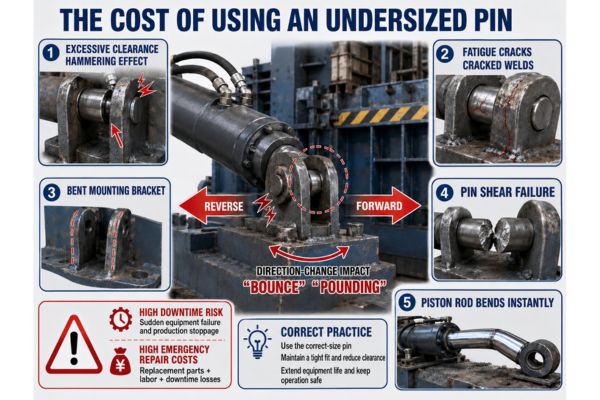
Using an undersized pin results in rapid wear and structural failure of the baler hydraulic cylinder attachment points due to constant impact loading. Every time the cylinder reverses direction, the gap between the pin and the eyelet allows the cylinder to “jump,” creating a hammer effect. This localized impact force is significantly higher than the static load the machine was designed to handle, leading to cracked welds and bent mounting brackets..
Does Vibration Lead to Rapid Pin Shearing?
When a pin is too small, it vibrates within the eyelet, which creates microscopic cracks in the metal through a process called fatigue. Eventually, these cracks grow until the pin shears completely, potentially sending the cylinder flying and causing injury or further damage.
- Vibration acts like a saw against the mounting bolts.
- Sheared pins often happen during peak production hours.
- A broken pin can cause the cylinder rod to bend instantly.
How Does Excess Play Impact Structural Integrity?
Excess play allows the cylinder to move out of its intended plane of motion, which puts massive stress on the frame of the baler. This can lead to the “ovaling” of holes we discussed earlier, making the machine impossible to repair without major structural rework.
- Play in the pin causes the cylinder to “hunt” for its center.
- This side-to-side motion weakens the main pivot points.
- Repairing a wallowed-out frame hole costs thousands in labor.
Can a Small Deviation Break Your Baler Hydraulic Cylinder?
Yes, even a millimeter of deviation can cause the baler hydraulic cylinder to experience side-loading, which destroys seals and bends the piston rod. Hydraulic cylinders are designed to push and pull in a perfectly straight line; any deviation caused by a loose or misaligned pin forces the internal piston to press against the side of the barrel. This metal-on-metal contact creates heat and friction that standard hydraulic fluid cannot lubricate, leading to internal scoring and catastrophic failure.
You might think a small wobble is “good enough” for a farm or recycling baler, but precision is non-negotiable. Modern high-pressure systems operate at levels where any misalignment is magnified into thousands of pounds of destructive force.
Does Misalignment Cause Premature Piston Seal Failure?
When the rod is pushed to one side by a loose pin, the piston seal is compressed on one side and pulled away on the other. This allows high-pressure oil to bypass the piston, resulting in a “drifting” cylinder that cannot hold its load.
- Side-loading creates “leaking” symptoms without external oil.
- Seals wear out in weeks instead of years.
- Heat from friction further degrades the seal material.
Why Do Side Loads Damage the Cylinder Barrel?
The piston is usually made of a harder material than the cylinder barrel to ensure long life, but under side-load, it acts like a boring tool. It will gouge deep grooves into the inner wall of the barrel, making the entire cylinder non-repairable.
- Scored barrels cannot be “honed” back to health.
- The piston can eventually get stuck in a gouge.
- Metal shavings from the barrel will contaminate your entire hydraulic system.
Will a Loose Pin Cause Hydraulic Fluid Leaks?
While the pin doesn’t touch the oil directly, the vibration it causes travels up the rod and vibrates the gland seals. These seals are the primary barrier between your oil and the outside world, and they cannot maintain a tight fit if the rod is constantly shaking.
- Vibration-induced leaks often look like seal defects.
- A loose pin can shake hydraulic fittings loose over time.
- Oil leaks create environmental hazards and slip risks.
Keeping your pins perfectly sized is the most effective way to prevent your cylinder from eating itself from the inside out.
| Component | Damage Type | Severity | |
|---|---|---|---|
| Piston Rod | Bending/Buckling | Critical – Requires replacement | |
| Gland Seal | Tearing/Leakage | High – Causes oil loss | |
| Cylinder Barrel | Internal Scoring | Critical – Non-repairable |
What Steps Ensure a Successful Maintenance Schedule?
Creating a detailed specification log for every baler hydraulic cylinder allows you to order the correct hardware in advance. Instead of guessing or measuring in the dark during an emergency, you should have a “cheat sheet” for every piece of equipment in your facility. This proactive approach eliminates the stress of repairs and ensures that you always have the right parts on the shelf when a component finally reaches the end of its life.
How to Document Every Baler Hydraulic Cylinder Specification?
You should maintain a digital or physical folder for each machine that includes actual measured dimensions, not just part numbers. This should include the rod diameter, bore size, stroke length, and the exact pin dimensions for both ends.
- Take photos of the measurement readings for clarity.
- Note the brand and model of any aftermarket cylinders.
- Update the log every time a modification is made.
Why Maintain an Inventory of Correct Mounting Hardware?
Keep a small stock of the specific pins, bushings, and locking bolts used on your balers. These are relatively inexpensive items that can save you days of downtime if a pin shears or a bolt vibrates loose.
- Hardware is the most common “missing link” in repairs.
- Pins are often damaged during removal and shouldn’t be reused.
- Having spares allows for immediate replacement without waiting for shipping.
Can Standardizing Pin Sizes Simplify Future Repairs?
If you have multiple balers, try to use cylinders that share the same pin sizes whenever possible. This reduces the number of unique spare parts you need to keep in stock and makes it easier for your maintenance team to become experts on those specific components.
- Standardization reduces the chance of grabbing the “wrong” pin.
- It allows you to buy hardware in bulk for better pricing.
- It simplifies the training of new maintenance technicians.
By treating pin sizing as a critical part of your overall maintenance strategy, you protect your company from the hidden costs of equipment downtime and mechanical failure.
| Maintenance Task | Frequency | Benefit | |
|---|---|---|---|
| Update Spec Log | After every repair | Eliminates future guesswork | |
| Inspect Pins | Monthly | Catches wear before failure | |
| Grease Pivots | Weekly | Prevents seizing and galling |
In conclusion, ensuring you have the correct pin size is the most effective way to eliminate delays and protect your equipment. By measuring accurately, understanding tolerances, and verifying your parts before the work begins, you can maintain a seamless operation that avoids the pitfalls of custom machining and structural damage. Our mission at Topa is to provide you with the high-performance hydraulic solutions and technical expertise needed to keep your machines running at peak efficiency. We are dedicated to solving the complex engineering challenges that cost you money, delivering factory-direct quality you can trust. If you are ready to upgrade your hardware or need assistance with a custom specification, contact us today to speak with our engineering team.
FAQ
Can I use a slightly smaller pin if I’m in a hurry?
No, you should never use an undersized pin because the resulting vibration will destroy your cylinder seals and potentially crack the machine frame. The small gap creates an impact force every time the cylinder cycles, leading to rapid mechanical failure.
What’s the best way to remove a seized pin without damaging the eyelet?
The best approach is to use a combination of penetrating oil, localized heat on the eyelet, and a professional hydraulic puller. Avoid using a heavy sledgehammer directly on the pin, as this can “mushroom” the end and make it even harder to remove.
How do I know if my eyelet needs to be replaced instead of just getting a new pin?
You should measure the bore of the eyelet in multiple directions to check for ovalization. If the hole is more than 0.010 inches out of round, a new pin will not fix the problem, and you will need to replace the eyelet or the entire cylinder.
Can I reuse an old pin with a new baler hydraulic cylinder?
Yes, you can, provided the pin shows no signs of wear, scoring, or “hourglassing” and meets the manufacturer’s original diameter specifications. However, given the low cost of pins compared to cylinders, it is usually safer to install a new, perfectly matched pin.
What’s the best material for a replacement baler pin?
The best material is hardened and ground 4140 or 1045 steel with a chrome-plated finish for corrosion resistance. Using standard “soft” steel will result in the pin bending under the extreme pressures typical of baling operations.