
How To Read A Hydraulic Cylinder Parts Description?
You are in the middle of the harvest season, and your tractor’s steering starts to wander or the loader bucket slowly drifts down while you’re trying to stack hay. You know it’s a cylinder issue, but looking at a parts catalog feels like deciphering a foreign language with terms like “rod glands,” “tie rods,” and “spherical bushings” blurring together. If you choose a replacement based on price alone without understanding these technical specifications, you risk a catastrophic failure just days later, leading to expensive downtime and ruined components. The solution lies in mastering the anatomy of your equipment; by accurately identifying each component through a professional hydraulic cylinder parts description, you can source high-performance replacements that outperform OEM standards and keep your operations running smoothly.
What Are The Main Components Of A Hydraulic Cylinder?
The main components of a hydraulic cylinder include the barrel, piston, rod, and head, which work together to convert fluid pressure into linear force.
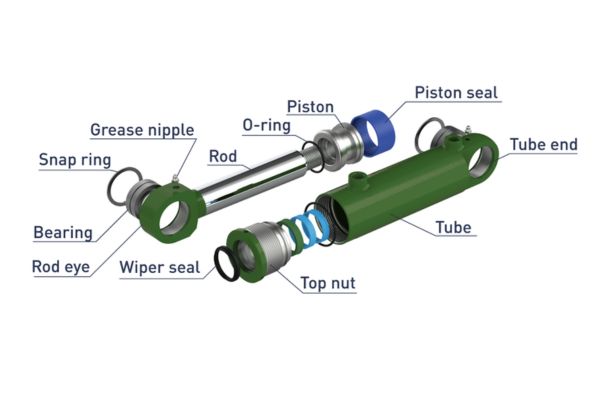
- Cylinder Barrel: This is the seamless steel tube that holds the high-pressure hydraulic fluid.
- Piston and Rod: The piston moves inside the barrel, while the chrome-plated piston rod extends to deliver force.
- Head and Gland: These seal the ends of the barrel and guide the rod’s movement.
You might be wondering how these parts stay leak-free under thousands of pounds of pressure.
- Primary rod seals prevent fluid from escaping the gland.
- Wiper seals keep dirt and farm debris from entering the system.
- Wear rings guide the piston to prevent metal-to-metal contact with the barrel.
| Component | Function | Material |
| Barrel | Pressure containment | Honed Steel Tubing |
| Piston Rod | Force transmission | Hard Chrome Plated Steel |
| Piston | Pressure isolation | Ductile Iron or Aluminum |
| Seals | Leakage prevention | Polyurethane or Nitrile |
Choosing the right material for these parts is the first step in ensuring your equipment survives harsh field conditions.
Why Does The Cylinder Barrel Material Matter?
The cylinder barrel material determines the maximum operating pressure and the overall durability of the unit against internal wear.
- Precision Honing: A high-quality hydraulic cylinder parts description will specify a honed interior finish to reduce friction.
- Wall Thickness: Heavier walls allow for higher PSI ratings without the risk of the tube “ballooning” under load.
- Corrosion Resistance: For agricultural use, exterior coatings protect the barrel from fertilizer and chemicals.
It gets even more critical when you consider the internal surface. The smoother the finish, the longer your seals will last.
- Rough barrels shred piston seals within a few hundred cycles.
- Mirror-finishes ensure a perfect oil film for smooth motion.
- Seamless tubing is preferred over welded tubing for high-pressure applications.
| Feature | Importance | Benefit |
| Honed ID | Low friction | Extended seal life |
| Seamless Tube | High strength | Safety at high PSI |
| Paint/Coating | Rust prevention | Long-term durability |
Investing in a barrel with a superior internal finish is the best way to avoid early internal leakage issues.
How Do Piston Rods Affect Reliability?
Piston rods affect reliability because they are the most exposed part of the cylinder and must resist both bending and corrosion.
- Hard Chrome Plating: A thick chrome layer protects the steel from rusting and provides a hard surface for the seals to ride on.
- Yield Strength: High-tensile steel prevents the rod from bending under side loads or sudden impacts.
- Surface Finish: A precise hydraulic cylinder parts description often lists the roughness (Ra) to ensure seal compatibility.
Think about the environment your equipment works in every day.
- Pitted rods act like sandpaper, destroying rod seals instantly.
- Bent rods cause binding and will eventually ruin the internal barrel surface.
- Induction-hardened rods offer superior resistance to rock chips and mechanical damage.
| Rod Type | Best Use | Key Advantage |
| Standard Chrome | General agriculture | Cost-effective protection |
| Stainless Steel | Marine/Corrosive | Maximum rust resistance |
| Induction Hardened | Construction/Mining | Impact and dent resistance |
A damaged rod is the most common cause of seal failure, so prioritizing rod quality is essential for long-term use.
What Is The Role Of Cylinder Heads And Glands?
Cylinder heads and glands serve as the closure for the barrel and the guiding mechanism for the extending piston rod.
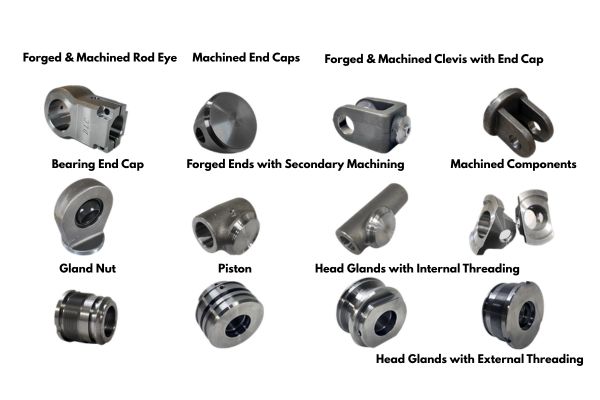
- Rod Guiding: The gland contains bushings that support the rod, preventing it from wobbling during the stroke.
- Seal Housing: It holds the critical rod seals and wipers that keep the hydraulic oil in and the dirt out.
- Mounting Interface: Many cylinders use the head or gland area for specific mounting hardware like trunnions.
You need to pay close attention to how the head is attached.
- Threaded glands are easy to remove for quick seal replacements in the field.
- Bolted heads provide maximum strength for heavy-duty industrial applications.
- Tie-rod designs use four long bolts to hold the entire assembly together.
| Head Type | Strength | Ease of Repair |
| Threaded | Medium | High (Field Serviceable) |
| Bolted | High | Medium |
| Tie-Rod | Medium | High (Universal Parts) |
Choosing a tie-rod cylinder design can often simplify your maintenance schedule due to the standard nature of the components.
How Do You Choose The Right Seal Kit?
Choosing the right seal kit depends on the operating temperature, fluid type, and the pressure your cylinder will face.
- Material Compatibility: Ensure the seals are compatible with the hydraulic fluid you use (mineral oil vs. synthetic).
- Temperature Rating: Nitrile is standard, but Viton seals are required for high-temperature or high-speed operations.
- Pressure Range: High-pressure seals use backup rings to prevent the seal from “extruding” under load.
But wait, there’s more to seals than just the material.
The configuration of the seal lips matters just as much.
- Buffer seals take the brunt of pressure spikes to protect the main seal.
- Excluder wipers remove ice or dried mud before they can reach the gland.
- U-cup designs offer the best static and dynamic sealing for most tractors.
| Seal Material | Temperature Range | Common Application |
| Nitrile (NBR) | -30°C to 100°C | General Purpose Agriculture |
| Polyurethane | -40°C to 80°C | High Pressure/Abrasion |
| Viton (FKM) | -20°C to 200°C | High Heat/Chemicals |
Matching your hydraulic cylinder parts description to your specific climate ensures you don’t face stiff steering during cold starts.
What Are The Different Cylinder Mounting Styles?
The different hydraulic cylinder mounting styles, such as clevis, pin-eye, or flange, determine how the cylinder is attached to the machine and how it handles force.
- Pivot Mounts: Clevis and pin-eye mounts allow the cylinder to pivot as the linkage moves, which is common on loaders.
- Fixed Mounts: Flange and foot mounts bolt the cylinder directly to a frame for rigid, straight-line movement.
- Alignment Tolerance: Pivot mounts are more forgiving of slight mechanical misalignments than fixed mounts.
The right mount can save your cylinder from premature failure. Side loading is the #1 killer of hydraulic rods.
- Spherical bearings allow for multi-axis movement, reducing stress on the rod.
- Clevis mounts are easy to swap but require frequent greasing of the pins.
- Trunnion mounts allow the cylinder to pivot at the center or head, saving space.
| Mount Style | Ideal Application | Major Benefit |
| Clevis | Tractor 3-Point Hitch | Easy installation |
| Flange | Industrial Presses | Maximum rigidity |
| Cross-Tube | Front-End Loaders | Strongest pivot connection |
Ensuring your mount matches the OEM specifications prevents the cylinder from binding and bending the rod.
Why Is Stroke Length Critical In A Parts Description?
Stroke length is critical because it defines the total travel distance of the rod and must perfectly match your machine’s mechanical limits.
- Travel Distance: If the stroke is too short, your loader won’t reach its full height or dump angle.
- Mechanical Stops: A cylinder should never act as the primary mechanical stop for a heavy arm, as this causes internal damage.
- Clearance: A hydraulic cylinder parts description must account for the fully extended length to ensure it doesn’t hit tires or frames.
You have to get the measurement exactly right.
Even a half-inch error can ruin your machine’s geometry.
- Measure the distance between pin centers when the cylinder is fully closed.
- Measure the distance again when the cylinder is fully extended.
- The difference between these two numbers is your actual stroke.
| Measurement | Definition | Why it Matters |
| Retracted Length | Pin-to-pin (Closed) | Fitting into the brackets |
| Extended Length | Pin-to-pin (Open) | Reaching the work target |
| Stroke | Total travel distance | Defining the movement range |
How Do Port Sizes And Locations Affect Power?
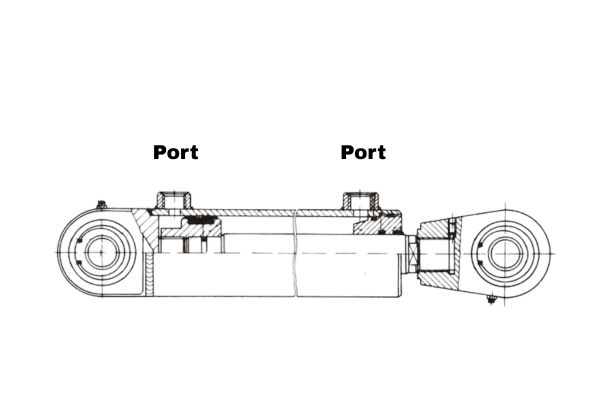
Port sizes and locations affect power by determining the volume of oil that can flow into the cylinder and the speed of the rod.
- Flow Capacity: Larger ports allow for more oil flow, which translates to faster cycle times on your equipment.
- Thread Standards: You must match the port threads (NPT, SAE, or BSP) to your existing hydraulic hoses to avoid leaks.
- Orientation: The hydraulic cylinder parts description must specify where the ports are relative to the mounts to prevent hose interference.
This is where many people run into trouble during installation.
Hose routing is just as important as the cylinder itself.
- Ports located at 90 degrees to the pins are standard for most tractors.
- Undersized ports cause the oil to heat up, reducing the life of your seals.
- Using the wrong thread type will strip the port and ruin the barrel.
| Thread Type | Region/Standard | Identification Tip |
| NPT | North America | Tapered threads, requires tape |
| SAE (O-Ring) | North America | Straight threads with a rubber seal |
| BSP | Europe/Asia | Parallel threads, uses a bonded washer |
What Are Tie-Rods Versus Welded Cylinders?
Tie-rod cylinders use high-strength bolts to hold the assembly together, while welded cylinders have the end caps welded directly to the barrel.
- Serviceability: Tie-rod cylinders are generally easier to disassemble and repair with basic hand tools.
- Compactness: Welded cylinders are more compact and can fit into tighter spaces, making them ideal for modern tractors.
- Durability: Welded designs are often stronger and better suited for heavy-duty construction or high-cycle applications.
Which one is right for your fleet?
It usually comes down to the application and space available.
- Industrial machines almost always use tie-rod cylinders for ease of rebuild.
- Mobile equipment like loaders prefers welded cylinders for their ruggedness.
- Welded cylinders eliminate the risk of tie-rod nuts loosening over time.
| Feature | Tie-Rod Cylinder | Welded Cylinder |
| Repair Speed | Faster (No welding) | Slower (May require cutting) |
| Mounting Options | Limited | Extensive |
| Pressure Rating | Up to 3,000 PSI | Up to 5,000+ PSI |
How To Use Technical Specs To Avoid Downtime?
Using technical specs allows you to match a replacement cylinder to the actual work load and environment of your machine, preventing premature failure.
- Pressure Rating: Never install a cylinder with a lower PSI rating than your tractor’s hydraulic pump output.
- Force Calculation: Ensure the bore size is large enough to lift your heaviest implements without straining the system.
- Material Traceability: Professional suppliers provide a hydraulic cylinder parts description that includes material certifications.
You need a systematic way to verify these specs before you buy.
Always ask for a technical drawing before placing an order.
- Verify the pin sizes match your existing hardware exactly.
- Check that the seal materials are rated for your local climate.
- Confirm the warranty and return policy in case of a fitment issue.
| Spec to Check | Consequence of Error | Recovery Strategy |
| Bore Size | Weak lifting power | Upsize the cylinder |
| Pin Size | Wobbly connections | Use bushings or resize |
| PSI Rating | Catastrophic burst | Match to pump relief valve |
By adhering to these technical details, you ensure that your replacement parts provide the reliability your business depends on.
Conclusion
Understanding a comprehensive hydraulic cylinder parts description is the difference between a successful repair and a recurring nightmare of leaks and downtime. By mastering the roles of the barrel, rod, and seals, you can choose components that are specifically engineered for your tractor’s workload. We have solved the mystery of complex hydraulic terminology and provided you with a roadmap to identify the exact parts you need. At TOPA, we provide the precision-engineered cylinders and technical expertise to ensure your machinery stays in the field during the busiest seasons. Our vision is to be the backbone of your hydraulic reliability, offering factory-direct quality that stands up to the toughest global standards. contact us today for your custom hydraulic needs.
FAQ
Can I replace just the seals if my cylinder is drifting?
Yes, in many cases, a simple seal kit can fix internal leakage issues. However, if the rod is pitted or the barrel is scored, new seals will fail quickly, and you should consider a full component review.
What’s the best way to measure a cylinder for a replacement?
The most accurate method is to measure the pin-to-pin distance in both the fully retracted and fully extended positions. This confirms both the fitment and the stroke length required for your machine.
How do I know if my cylinder rod is bent?
You can use a straight edge or a dial indicator along the length of the rod. Even a slight bend that is hard to see with the naked eye can cause the rod to bind and damage the internal seals.
Can I use a higher pressure-rated cylinder on my old tractor?
Generally, yes. Using a cylinder with a higher PSI rating than your tractor provides a safety margin and won’t harm the system, but you must ensure the physical dimensions and port sizes still match.
How do I identify the thread type of my hydraulic ports?
The easiest way is to use a thread gauge or compare the port to a known fitting. Note that North American machines typically use SAE or NPT, while European and Asian equipment often uses BSP.