
Hydraulic Cylinder Wiper Seals: How They Keep Dirt Out
Hydraulic cylinder wiper seals remove dirt and moisture from the piston rod as it retracts, helping keep external contamination away from the internal sealing system. They work with the rod seal and its lubricating film, so a dirty rod does not automatically mean the cylinder has ingested mud, and a slight sheen does not automatically mean seal failure. For equipment maintenance, the useful question is what the visible condition actually tells you. Understanding that distinction helps you document a problem accurately before cleaning, requesting an inspection, or ordering parts that may not address its cause.
What Hydraulic Cylinder Wiper Seals Actually Do
The wiper controls contamination at the point where the exposed rod enters the cylinder head. It is not a substitute for the internal seal that retains pressurized hydraulic fluid.

Follow the Rod Through the Cylinder Head
A wiper’s scraping lip contacts the moving rod and removes external debris before that surface travels farther into the head, also called the gland in many designs. Depending on its profile, the wiper may also participate in oil-film control, but its appearance alone does not identify the complete sealing arrangement behind it.
Understand the Limits of an External Barrier
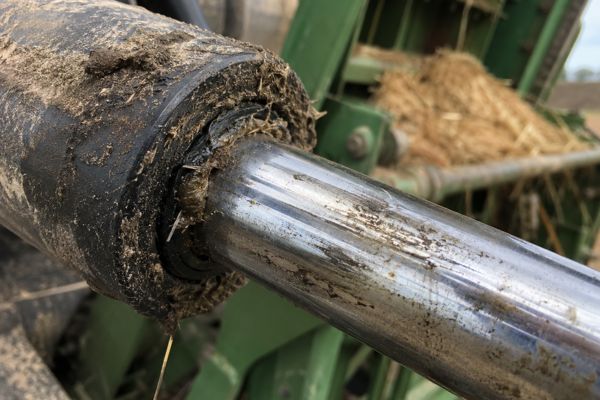
A working wiper reduces contamination entry, but it does not make the exposed rod immune to damage or establish that the oil inside is clean. Conversely, mud visible outside the head is evidence of exposure, not proof that abrasive particles have passed through the sealing system. Keep those observations separate in a work order: describe where the dirt is, whether the lip looks displaced or damaged, and whether oil is accumulating, rather than recording “internal contamination” without inspection evidence.
Why a Healthy Sealing System Needs an Oil Film
The rod and seals need controlled lubrication during sliding contact. Trying to make the rod completely dry is therefore not a reliable maintenance objective, and visible oil must be interpreted in context.
Separate the Wiper, Rod Seal, and Buffer Seal
The rod seal controls outward fluid leakage, while some heavy-duty arrangements include a buffer seal that protects it from pressure spikes. That buffer seal is part of the sealing package, not the cylinder’s end-of-stroke cushioning mechanism, and not every cylinder uses the same combination.
Judge Oil by Its Behavior, Not Shine Alone
A thin film lubricates the sliding interfaces, and the sealing system must manage that film as the rod extends and retracts. A sheen, a wet band, and repeated droplets are different observations, but none supplies a universal leakage limit without the applicable equipment criteria. Record whether the condition persists and how it changes during authorized operation rather than declaring every oily surface normal or every reflection a failed seal.
Why the Rod Surface Matters as Much as the Seal
The piston rod is the surface against which the sealing lips repeatedly operate. A replacement seal cannot, by itself, restore a damaged mating surface or correct the conditions that damaged it.
Look Beyond Whether the Rod Appears Polished
Scratches, corrosion, and damaged surface treatment deserve assessment, but brightness is not a measurement of surface suitability. Seal engineering considers surface characteristics more carefully than “smooth” or “rough,” so do not prescribe polishing, sanding, or a universal scratch-depth limit from a photograph.
Guiding components also matter because the sealing assembly operates within a mechanical arrangement, not independently of it. Wear rings carry transverse forces and help prevent metal-to-metal contact, so repeated seal problems should prompt an assessment of the guiding arrangement as well as the sealing lip.
What Dirt, Oil, and Movement Can Tell You
Visible conditions help direct an inspection, but they are not interchangeable diagnoses. Use the following comparison to describe a finding and choose the appropriate follow-up, not to authorize continued operation.
Compare Observations Without Jumping to a Cause
| Observation | What it establishes | Appropriate follow-up |
|---|---|---|
| Mud spots on the exposed rod | The rod has encountered external contamination. | Follow the equipment’s cleaning and inspection requirements; do not assume internal damage. |
| A light surface sheen | A visible film is present. | Compare its behavior with the model’s leakage criteria and previous observations. |
| Repeated wet accumulation at the head | Fluid is collecting in that area. | Request examination of the source and sealing condition; do not name the failed part from location alone. |
| A split, displaced, or missing wiper lip | The visible component requires assessment. | Record the defect and arrange repair review under the equipment procedure. |
| Scratches or corrosion on the rod | The mating surface may be compromised. | Obtain assessment against the applicable surface and repair requirements. |
| Slow, jerky, or drifting movement | The machine is showing a performance abnormality. | Record operating conditions and arrange system-level diagnosis. |
Keep Performance Symptoms Separate from Contamination Evidence
A slowing cylinder does not prove that mud has crossed the wiper, and drift does not automatically identify a piston-seal fault.
Inspect Safely Without Creating Another Problem
Separate observations made during normal operation from close inspection performed after shutdown. Do not approach a moving rod or restart equipment simply to obtain a better view of the seal.
Establish Safe Access Before Touching the Cylinder
Stop and isolate the equipment, lower the attachment or secure it with approved supports, and release hydraulic pressure and stored energy according to the machine’s procedure. Stopping the pump alone does not establish that all parts of the circuit are depressurized, and no inspection should depend on an unsupported raised attachment staying in place. Never use your hand to locate a pinhole leak;
- Rod: Note the location of visible scratches, pits, corrosion, or damaged coating without running fingers over a suspect surface.
- Wiper: Look for an obviously damaged or displaced exposed lip; do not probe behind it or remove retaining parts during an external check.
- Head area: Photograph existing oil and dirt patterns before approved cleaning, then record what was cleaned.
- Operating record: Add previously observed symptoms without recreating them during the static inspection.
Clean for Inspection, Not to Conceal the Finding
Use the cleaning method and materials permitted by the equipment manufacturer, and avoid improvised scraping with hard tools that could damage the rod. If the permitted method does not remove an obstruction safely, stop the cleaning attempt and refer it for maintenance assessment rather than applying greater force or an unknown solvent. A follow-up operating check, when required, belongs in an authorized procedure with people clear of the mechanism; it is not an invitation to wipe the rod while it moves.
Prepare the Evidence Before Ordering a Replacement
A useful repair request identifies the hydraulic cylinder and describes the finding without assuming the failed component. This gives the person assessing the job a better starting point than a cropped photograph of an oily ring.
Match the Part to the Complete Sealing Arrangement
Start with the cylinder identification and the current parts information, because an equipment model alone may not identify every cylinder position or installed revision. If comparison begins with a hydraulic cylinder product overview, use it only to establish the general component category, then obtain the exact drawing or approved replacement reference. Ask the reviewer to confirm the wiper profile, housing fit, material suitability, and relationship to the existing rod-seal arrangement before accepting a substitute. Similar diameter or appearance does not provide that confirmation, and an unverified part should not become a temporary repair for a pressurized system.
Send a Focused Inspection and Repair Checklist
- Identification: Machine model, cylinder position, cylinder markings, and existing assembly or seal-kit number when available.
- Finding: Exact location of dirt, wetness, or visible damage, with an overall photograph and a close view taken from a safe position.
- History: When the condition appeared, whether it followed repair or an impact, and what cleaning or maintenance has already occurred.
- Operating information: Hydraulic fluid identification and relevant documented operating conditions, rather than guessed pressure or temperature values.
- Technical confirmation: Correct part reference, applicable drawing, inspection findings, and the manufacturer’s installation and return-to-service requirements.
Keep factual observations separate from conclusions in the handover: “oil collected around the gland” is more useful than “wiper caused pump failure” when the latter has not been established. Ask the repair report to state what was inspected, what was found, and which condition justified replacing or retaining each relevant component. After the prescribed verification, retain the findings and part references with the maintenance record so a repeated problem can be compared with the previous repair. That record supports a more focused follow-up without inventing a fixed replacement interval or assuming that another seal kit will solve the same complaint.
Make the Next Maintenance Decision from Evidence
Hydraulic cylinder wiper seals help exclude dirt, but sound maintenance depends on interpreting the whole rod-end condition. A surface film, damaged lip, scored rod, and movement complaint each call for a different question, not the same automatic seal order. Before requesting repair, collect the cylinder identification, safe photographs, the location and persistence of oil, and any documented operating symptoms. Have the findings assessed against the installed equipment’s procedures and the correct component information. Matching the sealing arrangement matters more than choosing the cheapest ring or one that looks similar. Keep the inspection result and completed repair record together so the next decision starts with evidence rather than assumptions about what mud on a rod must mean.
Frequently Asked Questions
Does a double-lip wiper automatically perform better than a single-lip design?
No; the suitable design depends on the sealing arrangement and operating requirements. Additional oil-film control changes how the wiper interacts with the rod seal, so lip count alone is not a selection rule.
Should grease be applied to the exposed rod to stop dirt getting in?
Do not add grease as an improvised contamination barrier. Follow the cylinder manufacturer’s lubrication or preservation instructions, and distinguish any specified lubrication at mounting joints from treatment of the sliding rod surface.
Can a wiper be replaced without opening the cylinder?
That depends on the head construction and retention method. Consult the repair instructions before assuming the ring is externally serviceable; its visible position does not establish a safe removal procedure.
Is there one cleaning interval for every muddy jobsite?
No universal interval follows from the presence of mud alone. Use the equipment’s maintenance schedule and any instructions for severe operating conditions, then record unusual exposure or damage for maintenance review.
Can a clean-looking rod confirm that the hydraulic oil is uncontaminated?
No; external appearance cannot establish internal fluid cleanliness. If contamination is suspected, use the equipment’s specified diagnostic or fluid-assessment process rather than treating an intact wiper as proof that the whole system is clean.