
How to Maintain Hydraulic Cylinder End Cap Types for Maximum Reliability
Selecting the wrong hydraulic cylinder end cap types can trigger catastrophic system failures, costly downtime, and severe safety risks. Though small in appearance, end caps are critical for sealing high-pressure fluid and ensuring overall system integrity. A mismatched or poorly sealed design can cause more than a minor leak—it may result in total pressure loss under load, damage expensive machinery, and halt operations entirely. Each minute of downtime directly translates into lost revenue and productivity, all stemming from one overlooked component.
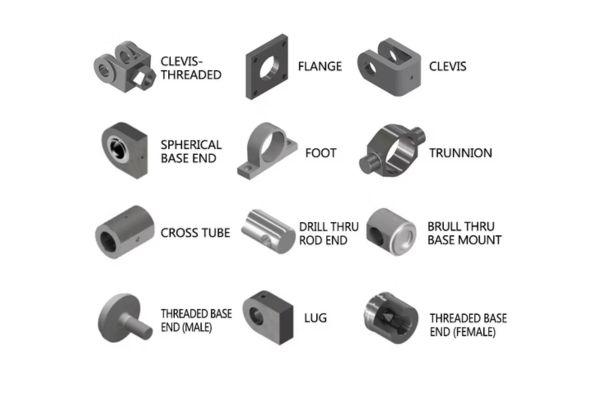
Core hydraulic cylinder end cap types
Why are end caps so critical to function?
Here’s the deal: end caps are the gatekeepers of your hydraulic cylinder’s power and integrity. They perform several essential roles that keep your machinery running smoothly and safely. Without a properly functioning end cap, the entire system is at risk of failure.
- Pressure Containment: They seal the cylinder, holding high-pressure fluid inside.
- Seal Housing: They provide a secure location for critical rod and wiper seals.
- Mounting Points: They often incorporate mounting features to secure the cylinder.
What is the main function of an end cap?
You might be wondering what an end cap actually does beyond just covering the end. Its primary job is to manage the transition from the static cylinder barrel to the moving piston rod. This involves sealing, guiding, and facilitating fluid flow.
- Sealing the cylinder barrel to prevent any external or internal leaks.
- Guiding the piston rod to ensure smooth, aligned movement.
- Connecting ports for hydraulic fluid to enter and exit the cylinder.
How do end caps actually prevent leaks?
But wait, there’s more: preventing leaks is a sophisticated job that relies on multiple components working together within the end cap. The design of the gland, which houses the seals, is just as important as the seals themselves. This system ensures fluid stays where it belongs.
- O-rings provide a static seal between the end cap and the cylinder barrel.
- U-cups act as dynamic rod seals to prevent fluid from escaping along the piston rod.
- Wiper seals stop external contaminants like dirt and moisture from entering the cylinder.
| Feature | Function | Importance |
| Pressure Containment | Seals the cylinder tube at both ends | Prevents fluid loss and maintains force |
| Rod Guidance | Supports and aligns the piston rod | Reduces wear on the rod and seals |
| Seal Housing | Holds static and dynamic seals in place | Critical for preventing external and internal leaks |
Guide to hydraulic cylinder end cap types
What are the primary attachment styles?
End caps attach to the cylinder barrel in distinct ways, offering specific advantages in strength and serviceability. Your choice impacts the entire cylinder’s design.
- Threaded.
- Welded.
- Tie-rod.
- Bolted.
How do materials impact performance?
Material choice for hydraulic cylinder end cap types directly influences pressure rating, durability, and environmental resistance. Correct selection is crucial for longevity.
- Ductile iron: Cost-effective.
- Steel: High strength.
- Aluminum: Lighter weight.
Which factors should guide your selection?
Choosing the correct hydraulic cylinder end cap types depends on assessing several critical factors. These considerations dictate the best balance of performance, cost, and maintenance.
- Operating pressure.
- Application (mobile vs. industrial).
- Serviceability requirements.
| Selection Factor | Consideration | Best For |
| Operating Pressure | Higher pressure, stronger design | Welded/bolted for high psi |
| Serviceability | Ease of disassembly | Threaded/tie-rod |
| Application | Compactness/durability | Welded for mobile; tie-rod for industrial |
Threaded hydraulic cylinder end cap types
What makes threaded caps so popular?
Threaded hydraulic cylinder end cap types are widely used due to their straightforward design and practical advantages. They are common where field maintenance is a priority.
- Easy assembly/disassembly.
- Cost-effective.
- Simple servicing.
Are there different styles of threads?
Yes, threaded hydraulic cylinder end cap types can feature various thread configurations. The threading method ensures a secure, leak-free connection when properly torqued.
- Internal threads.
- External threads (with nut).
- Fine vs. coarse pitch.
When should you avoid using threaded caps?
While convenient, threaded hydraulic cylinder end cap types have limitations unsuitable for demanding applications. Understanding drawbacks prevents premature failure.
- High-vibration prone.
- Extreme pressure limitations.
- Dynamic shock loads.
| Aspect | Pro | Con |
| Maintenance | Easy to disassemble | Can loosen under vibration |
| Cost | Generally cost-effective | – |
| Pressure Rating | Low-to-medium pressure | Not for very high-pressure |
Welded hydraulic cylinder end cap types
Why would you choose a welded design?
Welded hydraulic cylinder end cap types offer unparalleled strength and a compact footprint, making them a preferred choice for demanding applications. Their robust construction is designed for maximum durability.
- High strength.
- Compact design.
- Excellent durability.
What are the main drawbacks of welding?
Welded hydraulic cylinder end cap types present significant challenges regarding maintenance and repair. Their permanent nature makes servicing complex.
- Difficult to service.
- Higher manufacturing complexity.
- Risk of barrel distortion.
How does welding impact future repairs?
Repairing welded hydraulic cylinder end cap types is specialized and time-consuming, often needing professional intervention. It differs significantly from routine maintenance.
- Specialized labor needed.
- Risk to barrel integrity.
- Longer downtime.
| Feature | Advantage | Disadvantage |
| Durability | Extremely strong | Very difficult to repair |
| Design | More compact | Specialized repair skills |
| Best Use | Mobile applications | Applications needing frequent service |
Tie-rod hydraulic cylinder end cap types
How do tie-rods secure the end caps?
Tie-rod hydraulic cylinder end cap types are secured by external steel rods spanning the cylinder’s length. Threaded at both ends, these rods use nuts to pull end caps firmly against the barrel for robust assembly.
- Steel rods (four or more).
- End nuts for security.
- Barrel grooves for alignment.
What are the key benefits of this design?
Tie-rod hydraulic cylinder end cap types are renowned for their outstanding serviceability and modularity, making them a favorite in industrial settings. Their design facilitates quick and easy maintenance.
- Extremely easy to service.
- Readily available parts.
- Robust for industrial use.
Are tie-rod cylinders simple to service?
Yes, tie-rod hydraulic cylinder end cap types are designed for maximum serviceability, greatly reducing downtime during maintenance or repair. Their modular construction is a major advantage.
- Easy disassembly (remove nuts).
- Quick seal access.
- No special tools.
| Attribute | Description | Common Application |
| Construction | End caps held by external rods | Industrial presses |
| Serviceability | Easiest to disassemble | Minimize downtime |
| Design Footprint | Bulkier than welded | Stationary machinery |
Bolted hydraulic cylinder end cap types
What exactly defines bolted end caps?
Bolted hydraulic cylinder end cap types are secured by bolts passing through the cap into a corresponding flange or threaded holes on the cylinder barrel. This method provides a strong, removable connection.
- Direct fastening.
- High clamping force.
- Robust seal.
When are bolted caps the best choice?
Bolted hydraulic cylinder end cap types are well-suited for heavy-duty applications where both high pressure and maintainability are critical. They balance welded strength and tie-rod serviceability.
- Large-bore cylinders.
- High-pressure industrial applications.
- Needing strength and serviceability.
How do they handle extreme pressures?
Bolted hydraulic cylinder end cap types manage extreme pressures effectively because numerous bolts distribute hydrostatic load widely. This design prevents localized stress concentrations.
- Even force distribution.
- Robust sealing surface.
- Thicker material for strength.
| Feature | Bolted Caps | Tie-Rod Caps |
| Strength | Excellent for high pressure | Very good, but can stretch |
| Service | Serviceable, but many bolts | Very easy to service |
| Profile | More compact than tie-rod | Bulkier external rods |
Snap-ring hydraulic cylinder end cap types
How does a snap-ring retain the cap?
Snap-ring hydraulic cylinder end cap types utilize a circular snap-ring that fits into a precisely machined groove within the cylinder barrel. This ring holds the end cap or gland securely.
- Groove engagement.
- Minimal components.
- Quick assembly.
What are their primary limitations?
While simple and cost-effective, snap-ring hydraulic cylinder end cap types have significant limitations. These restrict their use to less demanding environments.
- Low pressure suitability.
- Limited robustness.
- Potential for dislodgement.
Are snap-rings viable for heavy duty?
No, snap-ring hydraulic cylinder end cap types are generally not recommended for heavy-duty applications or those involving significant pressures or dynamic loads. Their design prioritizes simplicity over strength.
- Not for high-pressure.
- Avoid high shock/vibration.
- Best for pneumatic/light hydraulics.
| Aspect | Snap-Ring End Caps |
| Best Use | Light-duty, low-pressure |
| Pressure Limit | Low |
| Key Advantage | Simple, low-cost |
| Key Disadvantage | Not secure for demanding use |
Comparing various cylinder end cap types
Which type is best for mobile equipment?
For mobile equipment, welded hydraulic cylinder end cap types are typically superior. Their compact design and exceptional resistance to vibration and shock loads make them ideal for rugged, dynamic environments.
- Welded rod cylinders.
- High vibration resistance.
- Sealed for life.
What about fixed industrial machinery?
For stationary industrial machinery, tie-rod hydraulic cylinder end cap types generally provide the best value. Their unparalleled ease of maintenance greatly reduces operational downtime.
- Tie-rod cylinders.
- Easy serviceability.
- Robust for continuous operation.
How does cost vary between these types?
The cost of hydraulic cylinder end cap types varies significantly by design, materials, and manufacturing. Generally, simpler designs are less expensive, while high-performance solutions command a premium.
- Snap-ring/Threaded: Most economical.
- Tie-rod: Moderate cost.
- Bolted/Welded: Higher cost.
| Application | Recommended End Cap Type | Primary Reason |
| Mobile (Excavator) | Welded Rod | Compactness/vibration |
| Industrial (Press) | Tie-Rod | Ease of maintenance |
| Light-Duty (Clamp) | Threaded/Snap-Ring | Low cost/simple |
Custom hydraulic cylinder end cap types
Can you design your own custom end cap?
When standard hydraulic cylinder end cap types don’t meet your unique application requirements, custom design and manufacturing are viable options. This path allows for highly specialized solutions.
- Unique applications.
- Optimized performance.
- Integration flexibility.
What info is needed for a custom design?
To design effective custom hydraulic cylinder end cap types, engineers need comprehensive information about intended operating conditions and desired performance. Precision ensures the final product meets expectations.
- Operating pressure/temperature.
- Fluid type.
- Dimensional constraints.
What are the typical manufacturing steps?
Manufacturing custom hydraulic cylinder end cap types involves a precise, multi-stage process to ensure high quality and performance. Each step, from design to final inspection, is critical.
- CAD design.
- Material selection.
- CNC machining.
| Step | Description | Key Output |
| 1. Consultation | Define requirements | Specification sheet |
| 2. Design & Modeling | Create 3D models | Approved CAD file |
| 3. Manufacturing | Machine the part | Finished end cap |
| 4. Testing | Pressure test/inspect | Certified component |
Servicing hydraulic cylinder end cap types
What are the most common failure points?
Regardless of the hydraulic cylinder end cap types, certain failure points are frequently observed, primarily due to wear, fatigue, or operational stressors. Recognizing early signs prevents greater damage.
- Damaged seals.
- Cracked caps.
- Stripped threads.
How do you safely replace an end cap seal?
Replacing seals on any hydraulic cylinder end cap types requires strict safety protocols to prevent injury and further damage. Always ensure the system is de-energized.
- Depressurize system.
- Disconnect lines.
- Remove end cap.
What basic tools are needed for service?
The tools for servicing hydraulic cylinder end cap types vary slightly by design, but some fundamental items are universal. Having the right tools ensures safe, efficient repair.
- Spanner wrenches.
- Torque wrenches.
- Seal picks.
| End Cap Type | Primary Service Tool | Common Failure Mode |
| Threaded | Spanner Wrench | Damaged threads/seals |
| Tie-Rod | Socket/Torque Wrench | Stretched rods/worn seals |
| Welded | Grinder/Welder | Cracked weld/seal failure |
| Bolted | Socket/Torque Wrench | Worn seals/bolt fatigue |
Conclusion
This guide has equipped you with the knowledge to differentiate between various hydraulic cylinder end cap types, empowering you to prevent system failures, reduce costly downtime, and enhance operational safety by making an informed selection. Contact our hydraulic systems experts today for a consultation or browse our extensive inventory to find the perfect components for your needs. O
FAQ
Q1: Can I replace a welded end cap with a threaded one?
No, this is generally not feasible. The cylinder barrel for a welded design is not manufactured to accommodate threads, and attempting to modify it would compromise its structural integrity.
Q2: What’s the best end cap type for a high-vibration environment?
A welded end cap is the best choice. Its monolithic construction offers superior resistance to loosening and fatigue caused by constant vibration, which is common in mobile machinery.
Q3: How do I know if my end cap seals are failing?
You’ll know if you see visible hydraulic fluid leaking from the rod gland or cylinder barrel end. Other signs include gradual pressure loss or a “spongy” cylinder response due to internal bypass.
Q4: Can I reuse the bolts or tie-rods when servicing a cylinder?
It is strongly recommended to use new fasteners, especially in high-pressure systems. Tie-rods and bolts can stretch or suffer from fatigue over time, and reusing them poses a significant safety risk.
Q5: What’s the best way to prevent thread damage on a threaded cap?
The best way is to use a proper spanner wrench that fits correctly and always apply specified torque. Avoid makeshift tools like a hammer and chisel, which can damage both the cap and threads.