
How Does Hydraulic Cylinder Maintenance Reduce Equipment Fail Risks
A massive 200-horsepower utility tractor screeches to an abrupt halt at the edge of a critical harvest field, its heavy front-end loader frozen halfway in mid-air because a localized pressure loss has completely paralyzed the fluid power transfer. This catastrophic operational stoppage hits right during peak operational windows, instantly resulting in mounting labor costs, compounding service penalties, and severe fluid contamination. To prevent these high-stakes operational crises, implementing a predictive, rigorous preventative routine serves as the primary engineering solution. Regular, rigorous hydraulic cylinder maintenance directly restores system pressure, prevents seal degradation, eliminates external fluid contamination, and protects critical heavy machinery from sudden mechanical failures.
Why Does Steering Drift Signal Piston Seal Failures?
Steering drift indicates a severe operational breakdown where internal high-pressure fluid directly bypasses the primary piston sealing elements. When a machine veers unprompted, the internal volumetric efficiency of the steering control loop has dropped below acceptable industrial tolerances.

This progressive pressure deterioration stems directly from micro-abrasions along the elastomeric seal lip. As fluid heat rises under heavy loading conditions, damaged seals allow high-pressure oil to seep into the low-pressure return chamber, rendering the mechanism unable to maintain its directional center point.
- Worn sealing elements allow high-pressure fluid to bypass the piston face directly.
- Volumetric efficiency drops rapidly as operating oil temperatures exceed normal parameters.
- Directional center control fails due to persistent pressure equalization across internal chambers.
Are you noticing that your equipment requires constant, minor steering corrections just to maintain a straight line? That is a textbook bucket brigade signaling that internal hydraulic stability has been seriously compromised.
| Structural Component | Primary Wear Indicator | Resulting Failure Mechanism |
|---|---|---|
| Primary Piston Seal | Micro-abrasion along the sealing lip | High-pressure fluid internal bypass |
| Cylinder Bore Wall | Linear scoring and deep micro-scratches | Accelerated seal material degradation |
| Rod Wiper Seal | Radial tearing and loss of lip tension | External particulate contamination ingress |
Can Low Fluid Levels Induce Internal Component Cavitation?
Low fluid levels directly introduce atmospheric air pockets into the suction side of the primary hydraulic circuit. When the pump draws a mixed air-fluid column, localized low-pressure zones cause microscopic vapor bubbles to form within the oil stream.
As these vapor bubbles transition into the high-pressure zones of the cylinder, they collapse violently with extreme force. This destructive phenomenon, known as cavitation, micro-blasts the internal metallic surfaces, stripping away protective coatings and pitting the precise cylinder bore walls.
- Microscopic air bubbles collapse violently upon entering high-pressure cylinder chambers.
- Micro-explosions strip protective material away from internal metallic components.
- Sustained cavitation results in rapid component pitting and structural wall erosion.
If the reservoir oil drop goes unnoticed, severe component erosion will occur within mere hours of high-pressure operation. You must implement a routine fluid tracking protocol to catch these volume drops before acoustic knocking begins.
| Operating Parameter | Safe Working Threshold | Cavitation Risk Zone |
|---|---|---|
| Fluid Level Metric | Above minimum sight glass indicator | Below suction port entry centerline |
| Operating Temperature | Between 45°C and 65°C maximum | Transgressing 85°C thermal threshold |
| System Pressure Status | Within OEM rated specifications | Exceeding relief valve cracking limits |
What Causes Severe Hard Steering During Heavy Loading?
Severe hard steering under load indicates an immediate breakdown of fluid film lubrication between the internal guide rings and the reciprocating piston rod. When heavy attachments create high mechanical side loads, the hydraulic cylinder rod is forced against the packing gland with excessive pressure.
This localized structural binding dramatically increases physical friction, demanding immense hydraulic pressure just to actuate the assembly. If system pressure cannot overcome this mechanical resistance, the steering wheel locks or requires extreme operator exertion.
- High mechanical side loads force reciprocating rods against internal packing glands.
- Fluid film lubrication ruptures under extreme localized cross-loading pressures.
- Physical friction escalates rapidly, causing immediate mechanical structural binding.
Is the mechanical assembly binding tightly only when your front-end loader bucket is packed to absolute maximum capacity? This classic symptom points directly to a severe physical alignment error or a bent rod assembly.
| Failure Mode | Direct Engineering Root Cause | Immediate Field Remedy Required |
|---|---|---|
| Mechanical Binding | Structural misalignment of mounting pins | Realignment and pin replacement |
| Thermal Seizure | Fluid film rupture from excessive side loading | Installation of heavy-duty guide rings |
| Pressure Spikes | Blocked internal porting or relief failure | Clearing ports and testing relief valves |
How Do Cracked Rod Wipers Permit Particulate Ingress?
Cracked rod wipers completely destroy the primary barrier protecting sensitive internal hydraulic components from aggressive environmental particulates. As a cylinder rod extends, it is exposed to highly abrasive dust, mud, and corrosive chemical fertilizers.

When the rod retracts through a damaged, brittle wiper seal, these fine particulates pass directly into the packing gland. The ingested grit embeds into the soft sealing material, transforming the seal into an abrasive surface that scores the chrome rod.
- Damaged wiper elements allow aggressive external particulates to slide past the gland.
- Ingested grit embeds deeply into soft internal elastomeric sealing compounds.
- Reciprocating scored surfaces rapidly abrade adjacent high-pressure rod seals.
Examine the forward edge of the cylinder gland closely during your next pre-shift inspection. A torn wiper element acts as an open gateway for environmental grit to destroy internal fluid purity.
| Wiper Seal Status | Particulate Ingress Risk | Expected Sealing Lifespan |
|---|---|---|
| Pliable Sealing Lip | Zero particulate bypass under normal conditions | Full operational hour rating reached |
| Brittle / Cracked Lip | Severe micro-particulate contamination bypass | Immediate breakdown of internal seals |
| Radial Tearing Present | Large-scale particulate and moisture ingress | Total system failure within short windows |
Why Does Hydraulic Fluid Discoloration Indicate Thermal Breakdown?
Hydraulic fluid discoloration indicates that the operating oil has surpassed its maximum thermal threshold, initiating molecular oxidation. When oil turns dark brown and emits a distinct, pungent odor, its protective anti-wear additives have completely broken down.
Oxidized fluid loses its essential high-temperature viscosity, causing the lubrication film within the cylinder walls to thin catastrophically. This thermal breakdown leads to direct metal-on-metal contact between the piston guide rings and the honed cylinder bore.
- Excessive operating heat initiates molecular oxidation of the hydraulic fluid.
- Essential anti-wear chemical additives degrade rapidly under sustained thermal stress.
- Lubrication film thinning permits direct metal-on metal friction within chambers.
Have you pulled the hydraulic dipstick only to find a dark, varnished residue coating the metallic surface? That dark fluid means your system is running too hot, and your internal components are wearing down fast.
| Oil Visual State | Fluid Oxidation Level | Lubrication Film Stability |
|---|---|---|
| Amber / Transparent | Zero oxidation; additives fully functional | Optimum fluid film strength maintained |
| Dark Brown / Opaque | Severe thermal breakdown and oxidation | Ruptured fluid film; high metal friction |
| Milky / Clouded | Extreme moisture contamination present | Drastic reduction in load-bearing capacity |
Can Bent Cylinder Rods Cause Rapid Gland Leakage?
A bent cylinder rod introduces a severe dimensional running error that forces the reciprocating shaft off-center during every stroke. Even a microscopic deflection across the rod length exerts severe, uneven mechanical pressure against one side of the hydraulic cylinder gland.
This localized force quickly crushes the rod seal on one side while creating a small gap on the opposite side. High-pressure hydraulic fluid easily escapes through this newly formed structural clearance, resulting in a persistent, heavy external leak.
- Dimensional running errors force the reciprocating shaft off-center during strokes.
- Uneven mechanical pressure crushes one side of the elastomeric rod seal.
- Microscopic structural clearances allow high-pressure fluid to escape externally.
Look for a distinct, heavy stream of oil escaping from only one side of the rod gland packing. A bent shaft will repeatedly destroy brand-new seals within minutes of installation unless the rod is replaced.
| Rod Deflection | Gland Pressure Balance | External Seal Integrity |
|---|---|---|
| Less than 0.05 mm | Perfectly balanced radial pressure achieved | Zero external fluid bypass observed |
| 0.10 mm to 0.30 mm | Moderate localized side-pressure loading | Progressive weeping during pressure cycles |
| Exceeding 0.50 mm | Severe structural seal deformation | Catastrophic external fluid blow-out |
What Structural Hazards Exist From Pitted Chrome Plating?
Pitted chrome plating creates microscopic, razor-sharp craters across the surface of the reciprocating piston rod. These sharp metallic edges act as micro-blades, slicing through the delicate lips of the high-pressure rod seals during every retraction stroke.
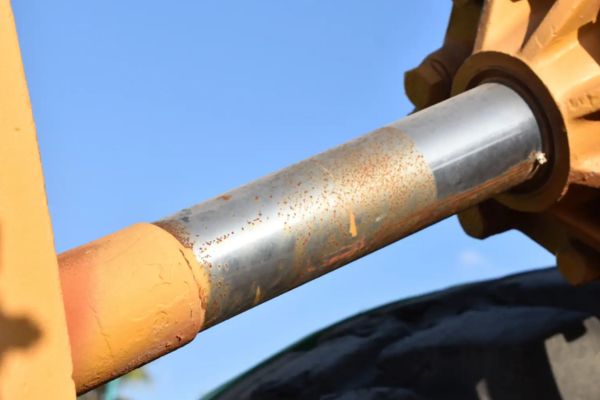
Furthermore, these tiny pits serve as micro-reservoirs that trap aggressive environmental moisture and corrosive air-slurry deep under the chrome layer. This hidden moisture fuels subsurface rust formation, causing the protective chrome plating to flake off completely.
- Sharp metallic crater edges slice through delicate elastomeric seal lips.
- Micro-reservoirs trap corrosive moisture beneath the protective chrome layer.
- Subsurface oxidation causes extensive flaking of the outer chrome plating.
Run a gloved finger along the extended rod section to feel for hidden surface roughness. If you detect any sharp, catching pits, those imperfections will shred replacement seals as quickly as you can install them.
| Chrome Plating State | Micro-Surface Profile | Impact on Internal Sealing Lips |
|---|---|---|
| Mirror / Polished | Consistent smooth surface profile achieved | Extended seal life with zero abrasion |
| Micro-Pitted Area | Sharp-edged metallic craters present | Rapid tearing of adjacent elastomeric lips |
| Large-Scale Flaking | Raw underlying steel exposed to elements | Complete destruction of sealing structures |
How Do Over-Torqued End Caps Induce Gland Binding?
Over-torqued end caps exert excessive radial clamping force directly onto the main hydraulic cylinder head packing gland. When assembly technicians ignore torque specifications and over-tighten the threaded cap, the internal metal structures deform slightly.
This dimensional distortion squeezes the guide rings and rod seals tightly against the reciprocating shaft, destroying the critical operational clearances. The resulting frictional binding generates extreme localized heat, blistering the seals and scoring the rod.
- Excessive radial clamping forces deform the cylinder head packing gland.
- Critical internal operational clearances are crushed by over-tightening caps.
- Frictional binding generates extreme localized heat that blisters seal materials.
Always use a calibrated torque wrench during reassembly to ensure every component is tightened precisely to OEM engineering specifications. Guessing cap tightness by hand frequently leads to costly gland binding and premature seal failure.
| Assembly Torque Level | Gland Dimensional Integrity | Frictional Temperature Rise |
|---|---|---|
| OEM Specified Torque | Perfect operational clearances maintained | Normal operating temperature stabilized |
| 20% Over-Torqued | Guide rings compressed against rod surface | Accelerated localized thermal spikes |
| 50% Over-Torqued | Severe structural deformation of gland | Immediate gland binding and seal failure |
How to Establish a Rigorous Hydraulic Cylinder Maintenance Program
Implementing a rigorous, standardized hydraulic cylinder maintenance protocol is the primary mechanical strategy to prevent unexpected pressure drops, eliminate external fluid contamination, and secure your long-term equipment investment.
Identify Progressive Chrome Plating Degradation
The reciprocating piston rod relies on an unbroken layer of hard chrome plating to maintain low-friction contact with internal seals. Technicians should run a gloved hand along the extended shaft to detect microscopic pitting, fine linear scoring, or localized flaking.
Evaluate Gland and Rod Wiper Integrity
The rod wiper seal serves as the primary defense barrier against environmental dust, moisture, and abrasive grit. Inspect the outer lip of the packing gland closely for signs of radial tearing, material brittleness, or uneven compression set.
Standardize Component Cleaning and Hone Inspections
Every disassembled component must undergo deep degreasing using industrial solvent washes before inspection. Examine the internal cylinder bore using a dial bore gauge to verify roundness and check for linear scratches.
Implement Calibrated Torque Specifications During Reassembly
A common error during cylinder rebuilds is tightening the head cap or retention nut purely by hand or with uncalibrated impact wrenches. Over-tightening deforms the internal gland geometry, exerting excessive radial pressure on the guide rings.
Conclusion
Implementing a predictive, structured maintenance strategy is the single most effective way to eliminate unexpected downtime and extend the lifespan of your heavy machinery. By taking action before components fail, you protect your business from costly repairs and dangerous operational accidents. If your system requires advanced assistance, contact us today to connect with premier fluid power specialists.
Frequently Asked Questions
Can I Repair a Scored Cylinder Bore Wall Myself?
No, you cannot safely repair deep internal barrel scoring without specialized industrial machinery. Minor surface blemishes can sometimes be removed using a high-precision flex hone, but deep grooves require professional boring and honing to restore the critical internal dimensions.
What Is the Best Method to Purge Trapped Air From a New Cylinder?
The best method is to cycle the newly installed cylinder lock-to-lock multiple times under zero load conditions. Extend and retract the rod slowly through its full stroke without forcing it against the mechanical stops.
How Do I Know If a Leak Is Coming From the Hoses or the Gland Seal?
You can easily isolate the leak source by thoroughly cleaning the entire assembly and performing a dry paper towel wipe test. Clean all oil residue from the rod gland, cylinder ports, and adjacent hose connections.
Can I Straighten a Bent Steering Cylinder Rod Using a Shop Press?
No, attempting to straighten a bent rod using a shop press is highly unsafe and creates severe structural risks. Straightening cold steel introduces micro-cracks into the metal matrix and damages the protective chrome plating.
How Often Should I Replace Rod Wiper Seals on Agricultural Equipment?
You should replace rod wiper seals immediately upon discovering any visible cracking, brittleness, or radial tearing during your pre-shift inspection.